Literary Route Web
Literary Route [Ruta Literaria], a WordPress editorial portal redesigned for editorial independence. 4,500 unique visitors and 15,000 page views in the first two months post-launch.

Literary Route Website
An editorial portal for reviews and collaborative writing.
LR-WEB-2019
THE GOAL
Help an independent literary portal scale its content without losing editorial clarity or visual identity.
Redesign the portal to increase content discoverability and support audience growth.
Success signals
More content explored per visit, lower drop-off on category pages, and a growing base of returning readers engaging across multiple sections.
SCOPE
I led the redesign end to end: information architecture, visual system, page templates, and full implementation in WordPress.
The project involved ongoing collaboration with the editorial team to ensure the CMS remained manageable for non-technical contributors. The scope covered the live site, not a prototype.
THE PROBLEM
The original site had outgrown its structure. A rigid single-column layout and no content hierarchy made it increasingly difficult for readers to discover what the portal had to offer.
User sentiment
No clear path into the archive beyond the homepage.
Content categories were hard to navigate and compare.
The site didn't reflect the editorial ambition of the team behind it.
RESEARCH APPROACH
Content and navigation decisions were informed by direct collaboration with the editorial team, ongoing review of how content was being added and consumed, and observation of where the existing structure created friction for both contributors and readers.
Methods
Perspective
Decisions were informed by observing how the structure created friction across two site versions.
Design criteria
Key findings
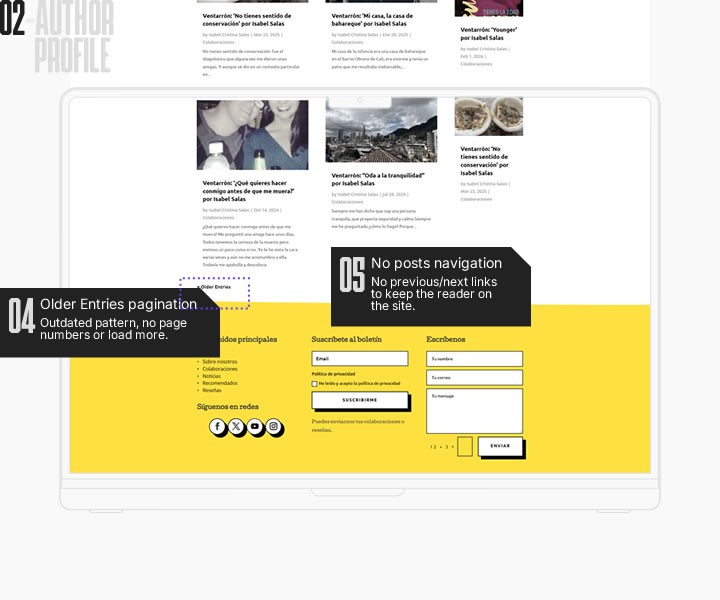
Pain-point audit
A screen-by-screen review of the original site identified structural and visual friction points across four key page types, homepage, author pages, category pages, and individual posts.




Affinity map
Research signals grouped into four recurring themes, the patterns that directly shaped the redesign decisions.

SYNTHESIS OUTPUTS
User types
Two distinct users shaped every structural and visual decision in the redesign.

The reader
About Occasional visitor who arrives through social media or search and reads one article at a time.
Occasional visitor arriving through social media or search.
Reads one article at a time, rarely explores further
Needs clear category navigation, content suggestions after finishing an article, and a reason to return.

The Contributor
About A writer or editor who publishes regularly, not a developer, and not dependent on technical support.
A writer or editor publishing regularly, not a developer
Needs a CMS they can operate independently, an author profile linked to their work, and a consistent page layout to publish into without starting from scratch.
Information architecture
The site is organised around five content types and a clear primary navigation, designed to reflect how the editorial team publishes and how readers naturally browse by category or author.
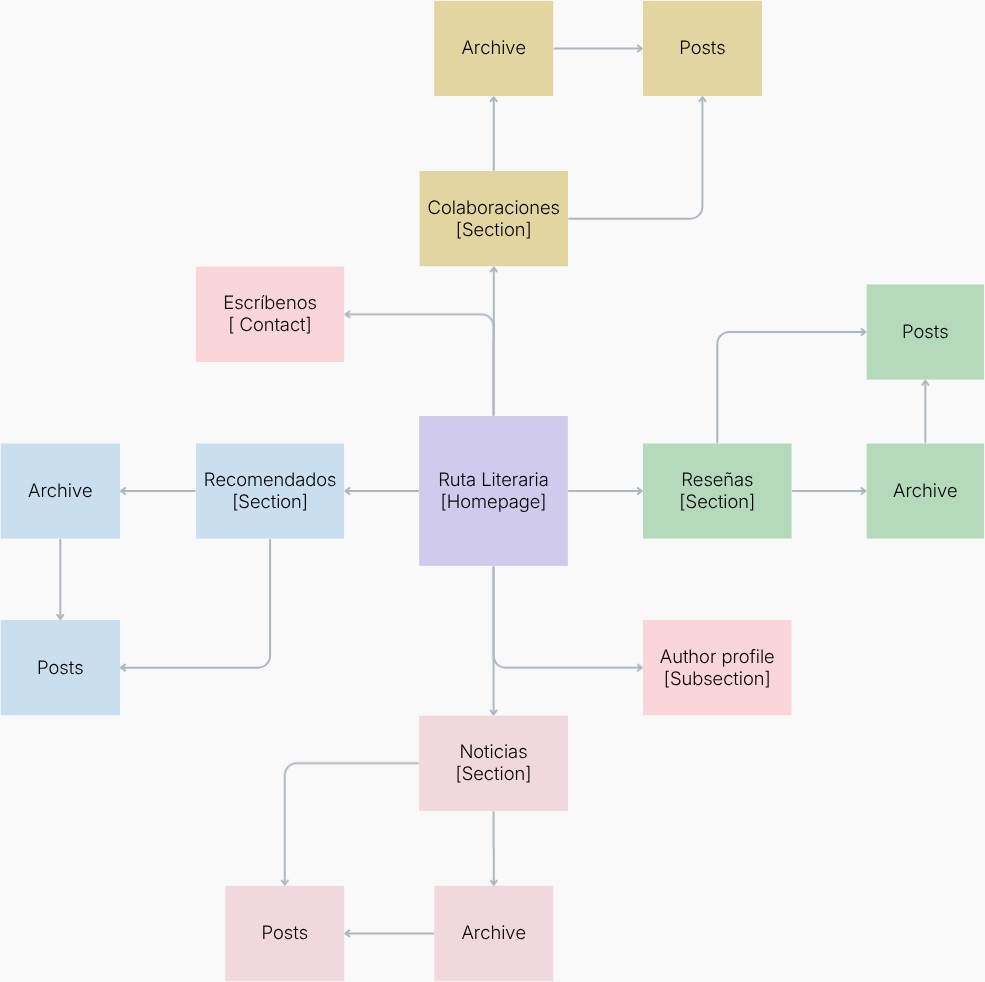
Structure principle: readers enter through any category and can navigate laterally across the site without returning to the homepage.
DESIGN PROCESS
The redesign was driven by structure before aesthetics, understanding how content was organised and consumed before making any visual decisions.
Key design decisions
Five structural and visual decisions shaped the redesign, each directly tied to a problem identified in the audit.
Together, these decisions transformed a rigid single-column site into a structured editorial platform, one the team can maintain and grow independently.
THE SOLUTION
The redesign replaced a rigid single-column layout with a structured editorial system, organised around content types, built for independent use, and designed to grow with the portal.
The primary reader journey — from entry to content discovery, navigation across page types, and the decision points that keep users engaged or take them off-site.

Core logic
Every page follows the same pattern: primary content on the left, contextual discovery on the right. Readers always know where they are and what to read next.


UI DESIGN
The visual system was built to give Ruta Literaria a consistent, recognisable identity, one that could be maintained by a non-technical team without breaking down over time.
Design tokens
A structured set of visual decisions applied consistently across every page type, colours mapped to content categories, an 8-point spacing grid, breakpoints for mobile and desktop, and a defined logotype with button states.

Typography
Open Sans was chosen as the single typeface for the entire system, used across headlines and body text in nine weight and size combinations.

These decisions form a lightweight but complete design system, one that doesn't require design knowledge to use. The tokens define the boundaries, the typography sets the tone.
OUTCOME
The redesigned portal launched mid-2023. Within the first two months: 4,500 unique visitors and 15,000 page views, documented in the team's public launch announcement.
By week five, the editorial team was publishing independently across all content types, no design support required. The site remains active today.
Before / After design comparison
Four page types. One consistent redesign decision: structure, sidebar, and editorial identity applied across the entire site.
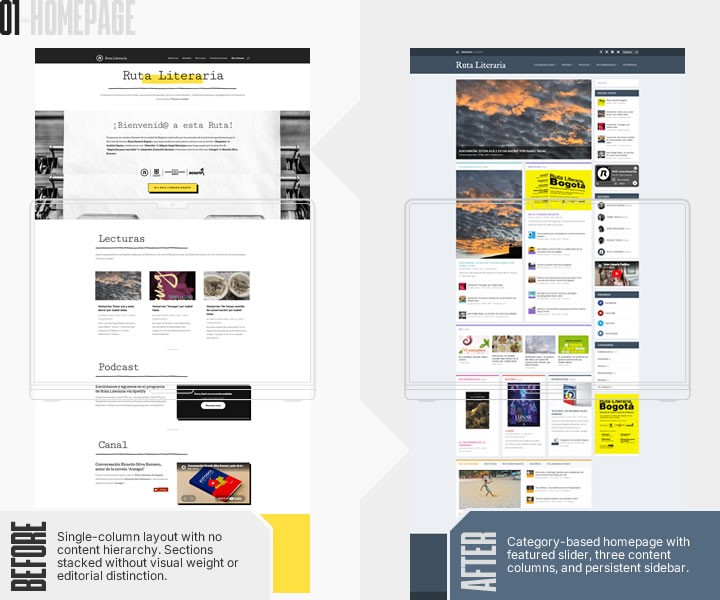


Learnings and reflections
The biggest gap: no Analytics baseline from the original site. If I were starting this project today, I'd connect tracking before touching a single template.
Learnings and reflections
Working on a live site means structure has to be right before build.
There's no room for mid-project pivots when an active team depends on the system daily.
The biggest gap: no Analytics baseline from the original site.
If I were starting this project today, I'd connect tracking before touching a single template.
Literary Route remains one of the most complete web projects in my portfolio, a live site, a real client, and a structure that's still being used today.

Literary Route Website
An editorial portal for reviews,
interviews and collaborative writing.
LR-WEB-2019